
Some of the links in this post are affiliate links. If you use the link to make a qualifying purchase, I'll make a small commission at no extra cost to you. As always, thanks for being here!
A complete guide to visiting the ruined but restored Agadir Kasbah, the only part of the city from before the 1960 earthquake that still exists. Find out the best ways to get there and what to expect both inside and outside the kasbah walls.
Sitting on top of a hill, high above the city and curved beach below, the Kasbah of Agadir Oufella is Agadir’s only landmark that pre-dates the devastating 1960 earthquake.
The outer wall of this historical fortress has recently been renovated and restored to its former glory, but sadly, most of the interior was destroyed in the earthquake and remains in ruins today.
We still went inside and explored, as a new walkway has been installed as well as lots of information signs about each area in the kasbah and what they once looked like.
But, while this was interesting and worthwhile, what makes the Oufella Kasbah one of the top attractions in Agadir is the scenic cable car ride to get there and the incredible views over the city and coastline!
So, even if you don’t fancy going inside to see the ruins, I’d still recommend taking the cable car, wandering around the outside of the walls, and taking in the tremendous view!
What Is The Kasbah Of Agadir Oufella? A Brief History
You may or may not have heard the word kasbah when travelling in Morocco, but for anyone unfamiliar with the term, a kasbah is a fortified section within historic North African medinas (walled cities).
Like in Marrakech and Taroudant, the reinforced kasbah was generally where palaces would be built and administrative leaders would reside, but in Agadir, it was the opposite way round. The kasbah was first constructed in 1572 as a defensive fortress, and over time, a medina and residential area developed within it.
The kasbah was an elevated stronghold and a protector of the port below, but it was abandoned in the 18th century when the port of Essaouira was established as the country’s main shipping harbour.
The Kasbah of Agadir Oufella flourished again when the Port of Agadir reopened in the early 20th century (as it still is today), until the city expanded southwards under the French, and people gradually left to move to this newer part of Agadir.
At the time of the 1960 earthquake, there were around 600 people living in the kasbah.
Another interesting thing about the Agadir Kasbah is that, like in the port city of Essaouira further north, it was another example of Muslim and Jewish communities living harmoniously side by side. There was both a mosque and a synagogue within the kasbah, although they of course now both lie in ruins.
It’s important to be aware that while we can visit and explore this historic hilltop fort, many of the victims who were in the kasbah at the time of the catastrophic earthquake still remain buried under the ruins. And so, while it’s a great tourist attraction where we can gain insight into the past, we must respect that the kasbah also acts as a tragic burial site and is a final resting place for many.
Next Read: Best Agadir Tours And Day Trips


Recent Restoration Work
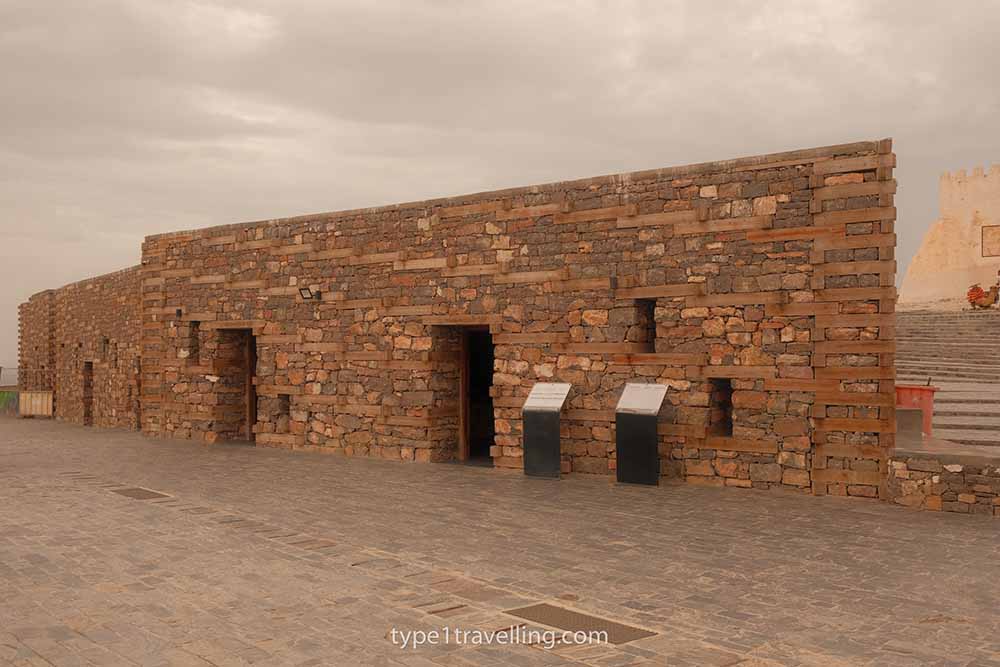
Major restorations of the kasbah began in 2020 with work to build the outer wall back up to its pre-1960 glory. On part of the eastern side of the wall, you can see a big crack that runs along about halfway up. The section below the crack is the original structure, and the section above is what has been rebuilt since 2020.
The inside of the kasbah has largely been left in the ruins in which it was found. It’s just been developed with the addition of a raised wooden walkway allowing visitors to explore, antique canons showing the main form of defence, and information signs which provide helpful context, facts, historical photographs, and stories.
This restoration work was completed in early 2024, which is when it fully opened to the public.
On the one hand, it would be quite incredible to see the full kasbah one day rebuilt and restored to its full grand state. But on the other hand, the ruins show the original character and, due to the tragedy of what happened in 1960, the site is more sensitive than an ordinary historical ruin.

Where Is The Kasbah Of Agadir Oufella?
The kasbah sits on a hill in the north of Agadir, 230 metres above sea level. If you look up from the city or beach below, you can just about see the outer walls strategically perched overlooking the coastline.
Find it pinned on Google Maps below.
How To Get There
There are a few ways to get up to the kasbah independently, including by cable car, taxi, bus, or walking, and I’ll go through each one in detail below.
The other option is to join a tour of Agadir’s highlights which includes a stop at the kasbah as well as the likes of Souk El Had and the Agadir Medina. This is a really convenient way to get around Agadir’s main sights (like Souk El Had, Agadir Medina, and Crocoparc) in one day, but most only visit for the views without enough time to actually go inside and explore the ruins.
This was the case on the Agadir tour we did with Bob (which is one of the best tours to book in Agadir), so we went back up on the cable car ourselves on a different day so we could spend some more time there.
If you’re only looking to visit for the view, then I’d actually recommend this tour, as it includes a ride on the cable car which I think shouldn’t be missed!
Book Here: Grab tickets in advance for this Agadir City Tour and cable car ride!
Cable Car (Scenic Option)
Opening Times: 10am – 10pm
Adult Ticket Prices: 130 MAD return, 90 MAD single
Child Ticket Prices: 100 MAD return, 80 MAD single, free for children under 80cm
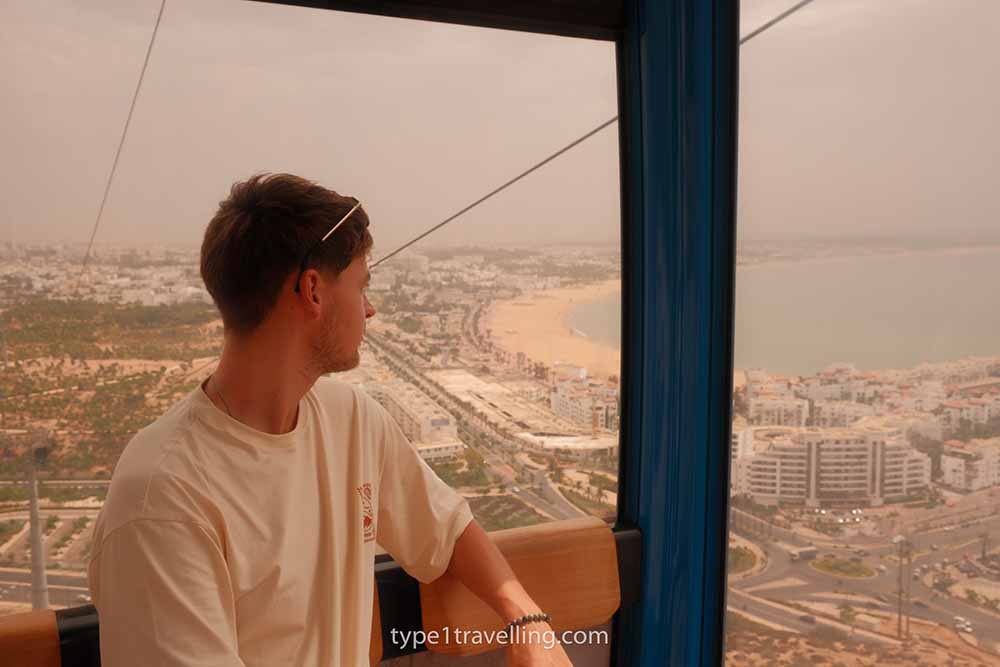
An attraction in itself, the best way to get up to the Kasbah of Agadir is on the cable car. It’s the first (and currently only) cable car in Morocco, and it’s a fantastic experience to gradually rise higher while the views of the city get better and better!
To take the cable car, you first have to get to Station Téléphérique – Cable Car Station in the north of the city. The station is best reached by taxi as there are no buses that stop nearby and we used the taxi app InDrive for this (as well as getting around other parts of Agadir).
You can buy standard tickets inside the station, or there are two private cabin options. These are a standard eight-person cabin for 950 MAD round trip or a four-person VIP cabin for 800 MAD round trip.
Whichever type of cabin you choose, the views are spectacular, and our journey up took about 10 minutes.
Once at the top station, you’re just a short distance from the kasbah ramparts, ticket office, and main entrance.

Fancy Seeing Agadir City And The Kasbah Lit Up At Night?
Secure Your Night Cable Tickets In Advance
Taxi (Easy Option)
Taking a taxi is the easy option and the only direct way to get to the kasbah from the city if you’re not on a tour.
We preferred to use the InDrive app (similar to Uber) to get taxis in Agadir as we found it generally cheaper and easier than hailing one. Although just be aware it’s not officially recognised in Morocco, so the drivers don’t like to pick up or drop off in places where official taxis are congregated. Therefore, they might not be willing to take you all the way to the entrance.
For official taxis, you can hail the small orange ‘petit taxis’ on the street and either agree on a price or ask to use the meter – our Airbnb host recommended the latter.
For catching a taxi back, we saw a few waiting around the entrance area so I don’t see there being a problem finding a ride.

Public Bus (Budget Option)
The cheapest way to get there (if you don’t want to hike) is on the public bus. However, there isn’t a direct route from the city up to the kasbah.
Instead, you need to first take a bus as close as you can to the bottom of the hill that the kasbah sits on, and then take the L24 bus from there. The L24 is the only bus that goes as far as the entrance and it’s basically a shuttle between the kasbah and the main road below.
Leaving every 30-40 minutes, it costs 4 MAD each way for the five-minute journey.
The easiest way to plan this is using Google Maps as it shows which bus numbers to take, or you can find details on the ALSA website too.
Related Post: Best Things To Do In Agadir
Walking (Active Option)
As well as the winding road, there’s also a 2.8km walking trail from the bottom of the hill that zigzags up to the kasbah entrance. So, hiking up is an option if you fancy it. However, the start of the trail is pretty far from the other parts of the city so, unless you’re staying near the marina, you’ll likely need to get a bus or taxi first.
We opted to take the cable car up and then walk back down and found that although the trail is official and purpose-built, it’s actually very uneven so we spent more time watching our footing than taking in the views!

Entrance Fee And Opening Times
The inside of the kasbah is open from 10am year-round and closes at 8pm in the summer, 7pm in the winter, and 4.30pm during Ramadan.
Tickets cost 90 MAD for adults, 65 MAD for 7-17 year olds, free for children under seven, and 300 MAD for a family ticket.
There is also an option to add an audio guide for 30 MAD or a guided tour for 100 MAD.
We bought our tickets at the ticket office which is located next to the upper cable car station (not the kasbah entrance gate) or you can purchase them online and they’ll be valid for three months.
What To Expect
Whether you get there by cable car, road, or on foot, you’ll arrive at the paved and developed entrance area next to the majestic kasbah outer wall. Here, you’ll find the ticket office, a small snack shop, souvenir stalls, camels to ride, and excellent views over the city below.
There are also information signs about the history, earthquake, and restoration as well as a path that continues past the kasbah entrance gate, around the wall, where there are views to the north and over the port.
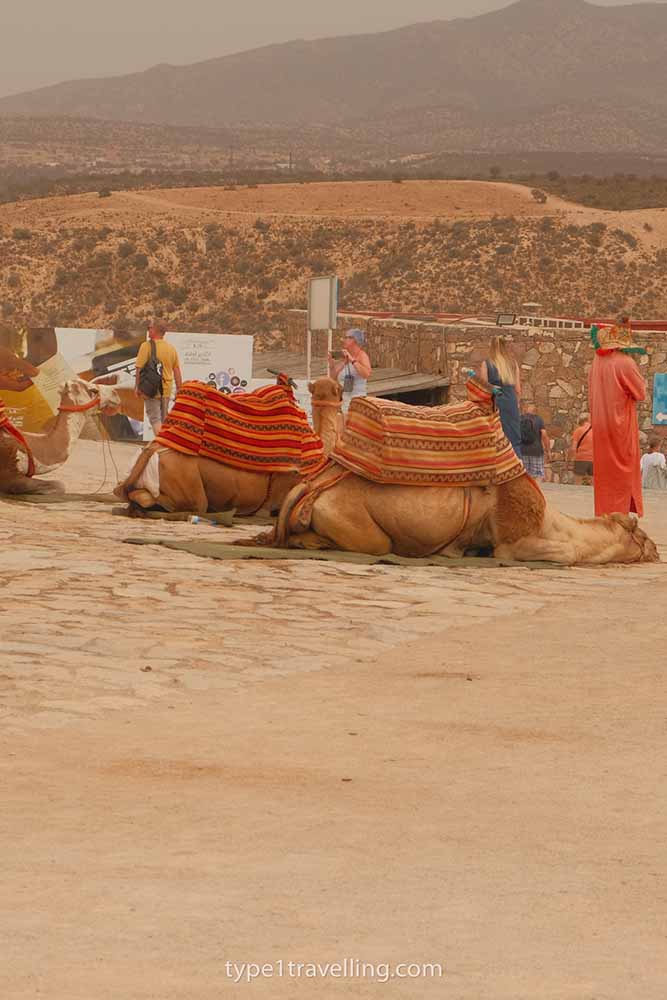


After arriving via cable car, we bought our tickets and spent a few minutes admiring the epic view of Agadir and snapping some photos before heading up the path towards the entrance gate. At the gate, our tickets were checked, and we were ushered inside and advised on the general direction in which to follow the wooden walkway.
The walkway, which roughly follows the layout of the kasbah’s historic streets and alleys, is raised above the ground as many of the victims of the earthquake remain buried here. It’s therefore important to stick to the designated path out of respect.
There’s also a map of the kasbah close to the entrance showing all the points of interest, which are numbered, so we just followed this order.
We weren’t too sure what to expect inside, but we quickly realised that only the outer wall had been restored and the interior had generally been left in its ruined state – with the addition of the walkway, information signs, and a few real but non-original canons.
Therefore, we needed a bit of imagination to envisage what it once looked like, but we were aided by the information signs (in English, Arabic, and French) at each point of interest. These gave helpful context, facts, historical photographs, and stories, and while ruins aren’t as exciting as preserved structures to look at, it was still interesting to learn all about what life had been like inside the kasbah.
We took our time wandering around the walkway, reading the information signs, and looking out at the views, and it was almost an hour before we were back at the entrance, ready to make our way back down to the city.


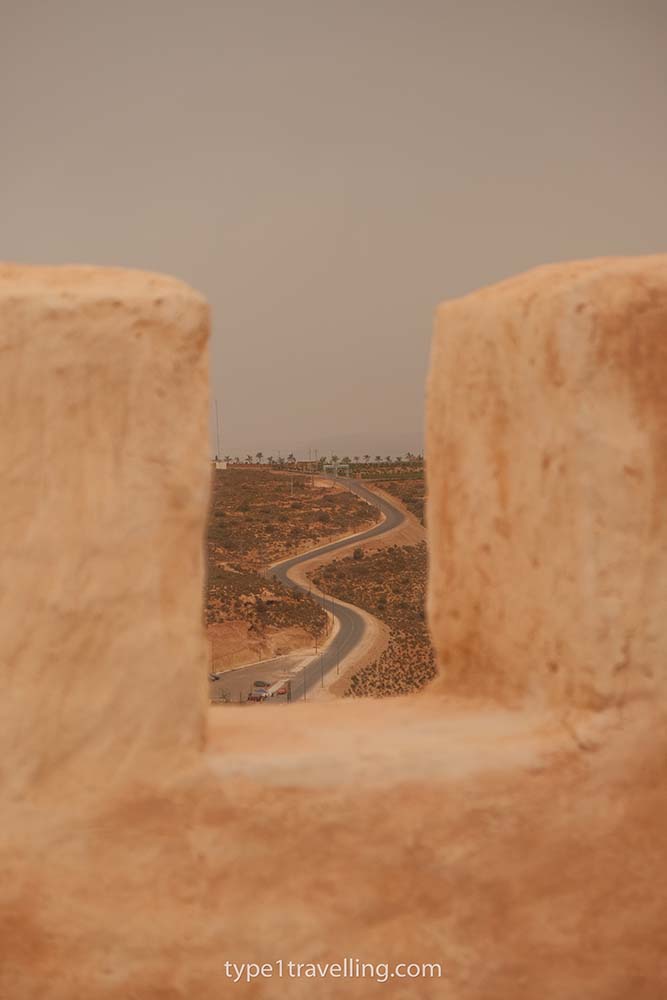
Travel Tip: The weather in Agadir can be hazy and foggy, especially in the morning and during the summer months, so check the forecast and try to visit on a clear day for the best views if you can!
Don’t Miss This Unforgettable Quadbiking Tour Too!
We loved this highly rated trip and you can reserve in advance here.
Best Things To See In The Kasbah
There are 30 points of interest inside the kasbah, and it’s worth taking your time to read the information about each one.
However, below I’ll include the best things to see and look out for as you explore.
These are in addition to the various viewpoints you’ll come across on the outer wall.
The Kasbah Gate
Impossible to miss, as it’s the only way to get inside, the gate of Kasbah Agadir Oufella has been restored like the fortified wall around it.
It’s not so much that it’s grand or detailed like other Moroccan archways, but rather it’s such a poignant and picturesque feature that adds a lot of character to the impressive structure.

The Marble Cartouche
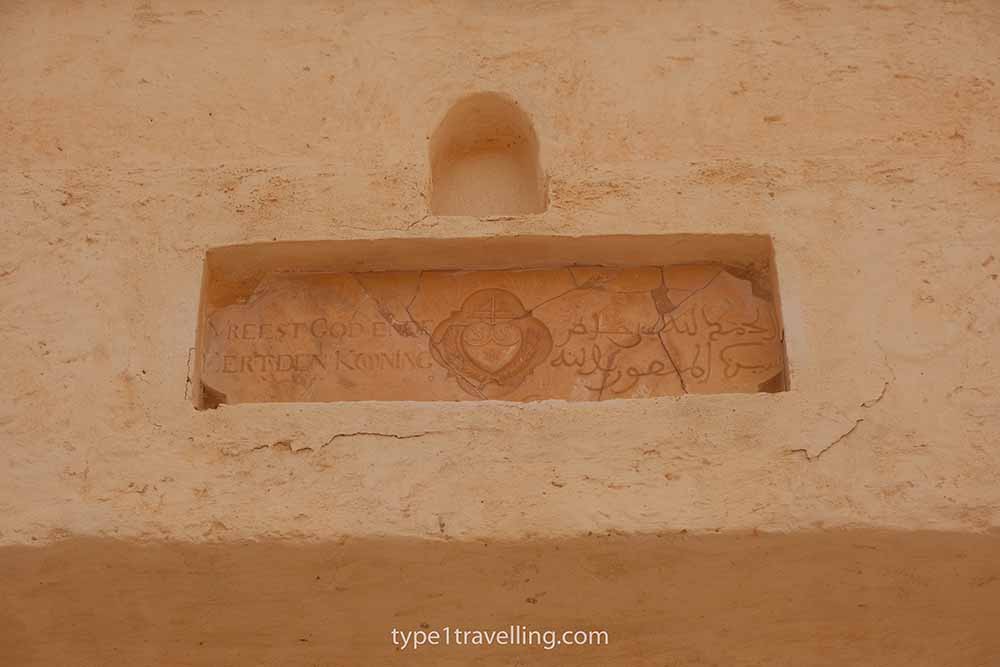
Much easier to miss is the white marble cartouche that is showcased directly above the kasbah gate.
Dated 1746 and featuring Dutch and Arabic inscriptions, it was removed during the restoration project and photographed in 3D for its conservation before being returned to its original place above the gate once the structure was ready.
The Canon Platform
One of the first sections that we came across inside the kasbah was the canon platform looking out over the city.
Around 12 canons were situated around the kasbah and protected the fortress and its access points from attacks coming from the mountains, the port, and the ocean.
The canons on display today aren’t the originals but they are authentic models with some dating back as far as the 16th century!

The Mosque Ruins
Like the other areas, there’s next to nothing left of the mosque that once stood inside the kasbah.
However, among other things, there are the ruined remains of the preaching pulpit, where you can even see some original colours in the structure.


The Hammam
Next to the mosque are the ruins of the traditional hammam, which had originally opened in 1953. It was open to the residents (women in the morning and men in the evening) for seven years until the earthquake hit in 1960.
What is particularly interesting about this part of the kasbah, though, is the small section of tiles that are still intact and showing their original pattern.
The hammam tradition is still well and truly alive in Morocco today, and it’s definitely worth experiencing while in Agadir!

The Sanctuary Of Lalla Yamna N’Sidi Brahim N’tghanimine
In the northern part of the kasbah, this sanctuary is one of the main things to see, as it’s the only section inside the fortress that was rebuilt after the earthquake.
It isn’t open for visitors to go inside, but you can see down into the restored sanctuary with its rebuilt walls and doorways from the walkway.

To Finish
Overall, a visit to the Agadir Kasbah should definitely be on your list of things to do during your trip to the coastal city!
Even if a wander around the interior ruins isn’t your cup of tea, the epic views from the outside still make a trip to the kasbah worthwhile!
More Morocco Travel Guides
Heading elsewhere in Morocco? Find more detailed travel guides filled with helpful information and inspiration for your trip below.
- A Complete Guide To Tamraght
- Ultimate Taghazout Travel Guide
- Best Beaches In Taghazout
- Is Paradise Valley Worth Visiting?
- How To Visit Taroudant From Agadir
- Getting From Agadir To Taghazout: All You Need To Know
- Essential Imsouane Morocco Travel Guide
- A Guide To Essaouira’s Beaches
- How To Get From Marrakech To Agadir
